


Why Strategy Workshops Matter for Nuclear Energy Organizations
- Lenka Kollar

- Feb 18
- 4 min read
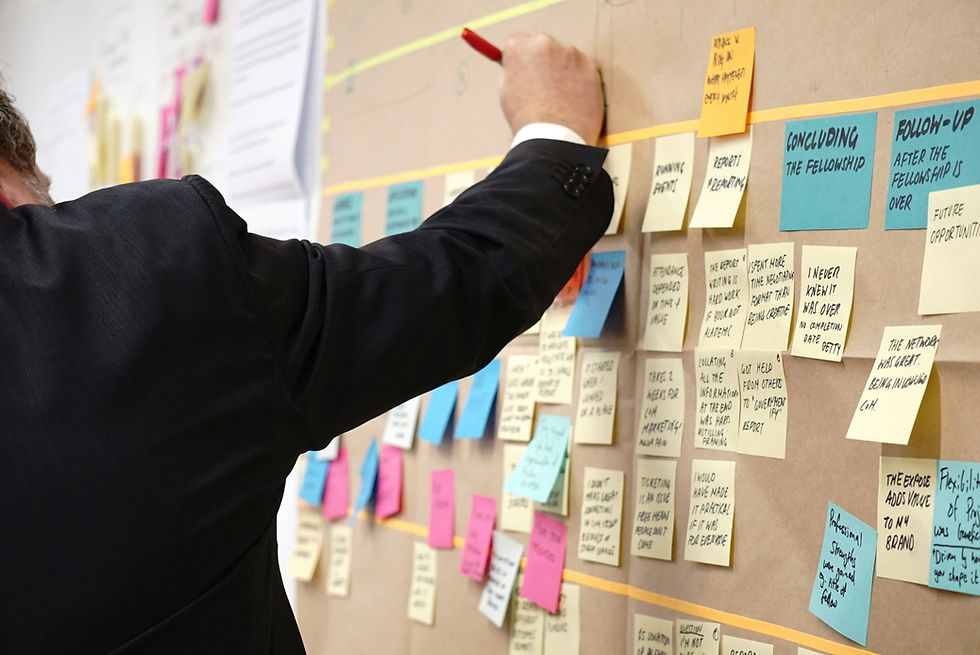
The leadership team left the strategy session two hours ago. If you asked each of them what the organization's top three priorities are, would they give you the same answer?
In most organizations, the answer is no. And that’s not because they aren’t organized or are being obstinate. It's because strategy usually fails in the room, not in the market.
Misalignment on strategy delays nuclear
Business school taught us how to make strategies to sell consumer products to a specified customer segment, but the nuclear industry is incredibly complex.
Nuclear strategy is death by a thousand priorities and misalignments. One executive thinks the priority is regulatory approval. Another believes it's demonstrating commercial viability. A third is focused on building the supplier network. When everyone pursues their own version of "what matters most," the organization fragments.
Everyone uses and is impacted by energy. The end user is often different from the customer, who may be different from the owner or operator. Add to that, thorny public views, regulatory uncertainty, and evolving political landscapes. Not to mention the technical challenges of harnessing the powers of the universe and dealing with a stagnated supply chain.
Resources get divided equally across every initiative because "everything is a priority." Leadership meetings become exercises in talking past each other. Strategic plans sit in slide decks, beautifully formatted and completely disconnected from how people actually spend their time and budget.
This misalignment is particularly costly in nuclear energy, where timelines span years, capital requirements are massive, and regulatory complexity means you can't easily pivot.
Case study: running an effective workshop for nuclear research and education
We recently worked with a nuclear department at a university with an ambitious vision: become the leading talent pipeline in the nuclear sector while building world-class research programs. The problem wasn't the vision, but that different members of the organization had different ideas about how to get there.
We pushed them through a simple exercise: "It's 2030, your organization just won awards from the university, the government, and a nuclear trade association. What did each recognize you for?"
The conversation was divergent. Some imagined being recognized for research excellence and publications. Others pictured industry partnerships and practical training. Others focused on safety culture and regulatory expertise. Diversity and community outreach were marked as non-negotiables.
Starting with divergent thinking allowed us to converge on the things that really matter to achieve the vision. Workshops matter because you can't fix misalignment through email. You need people in a room, forced to articulate what success looks like, and then make explicit trade-offs when those visions conflict. You also need to bring people along on the strategic journey to create buy-in.
By the end, this team had something they didn't have before: a shared language. Four strategic initiatives (not fifteen). Explicit choices about what they'd stop treating as equally important. Specific outcomes for 2030 and clear actions to take in the next 1-2 years to get there.
Case study: Go-to-market strategy for commercializing an advanced reactor
A commercial advanced reactor company came to us needing to figure out their go-to-market strategy. They had innovative technology but faced the classic challenge: limited resources, multiple potential customer segments, regulatory uncertainty, and pressure to show commercial traction.
We started by mapping their business model canvas, identifying their actual competitive advantages versus what they hoped they had. The founding team quickly realized that some of their assumed strengths weren't differentiated enough to matter in the market, while capabilities they'd taken for granted were actually unique.
Then came customer segmentation. The engineering team wanted to pursue technical performance buyers who would appreciate the reactor's reliability, while the commercial team saw faster traction with early adopters willing to pay premium prices.
The final decision on customer segmentation was made based on the opportunity for strategic partnerships.
The team needed an integrated roadmap showing how product validation, regulatory approvals, and market entry actually sequenced. Being in the same room to take the dedicated time to simply write out these timelines out on the whiteboard and map them to each other helped us make huge strides on that comprehensive roadmap and go-to-market strategy.
We identified critical dependencies where a delay in one area would cascade across the entire commercialization plan. And finally, set a plan for the next couple of quarters.
The need for external facilitation
Most CEOs and founders think they can get together with the leadership team once a year at an offsite and craft the company strategy. But the CEO should be a full participant in the conversation, not the person managing it. When you're facilitating, you're thinking about the process, time management, capturing outputs, and navigating group dynamics. You're not thinking deeply about the hard trade-offs your organization faces.
More importantly, you need a tested process and frameworks that force useful decisions versus which ones produce feel-good consensus. A good facilitator knows when to let debate continue and when to force a decision.
External facilitation is critical to crafting an effective strategy in the room that then translates to real actions and market success. We've run strategy workshops for nuclear companies and organizations at every stage of maturity: pre-seed startups figuring out their first customer, research centers navigating commercialization, established companies entering new markets, and governments developing national roadmaps.
Just as importantly, we bring nuclear industry knowledge. We understand the technical-commercial-regulatory triangle that every nuclear organization navigates. We understand the technologies, and focus on the commercialization.
The next time your investors or board members ask for the organization’s strategy, ask yourself, “Is this just a document to show we have a strategy, or do we actually use it to help us make decisions?”


