


Modelling the Fusion Energy Workforce

Updated: May 21
Fusion timelines depend on a workforce that can scale in parallel with technology, and that workforce doesn't appear on its own.
Fusion is usually framed through technology progress and deployment timelines, yet those trajectories depend on people. As more countries and companies move from research toward deployment, the structure and timing of workforce demand stops being a secondary question and becomes a central one.
We presented our strategic modelling framework for workforce readiness at the International Atomic Energy Agency (IAEA) Technical Meeting on Developing the Fusion Workforce. The framework brings together deployment modelling and labour analysis to examine how the fusion workforce evolves as the industry scales, linking reactor deployment with labour demand across geographies and lifecycle stages.
Workforce planning sits alongside technology and finance
The starting point is the recognition that workforce development is a core requirement for national fusion technology deployment. That places workforce planning alongside technology development and financing as a determinant of national deployment outcomes. Treating it as downstream is poor planning.
For more on how countries should prepare for fusion, see the Helixos Plasma Power Framework.
How the model is built
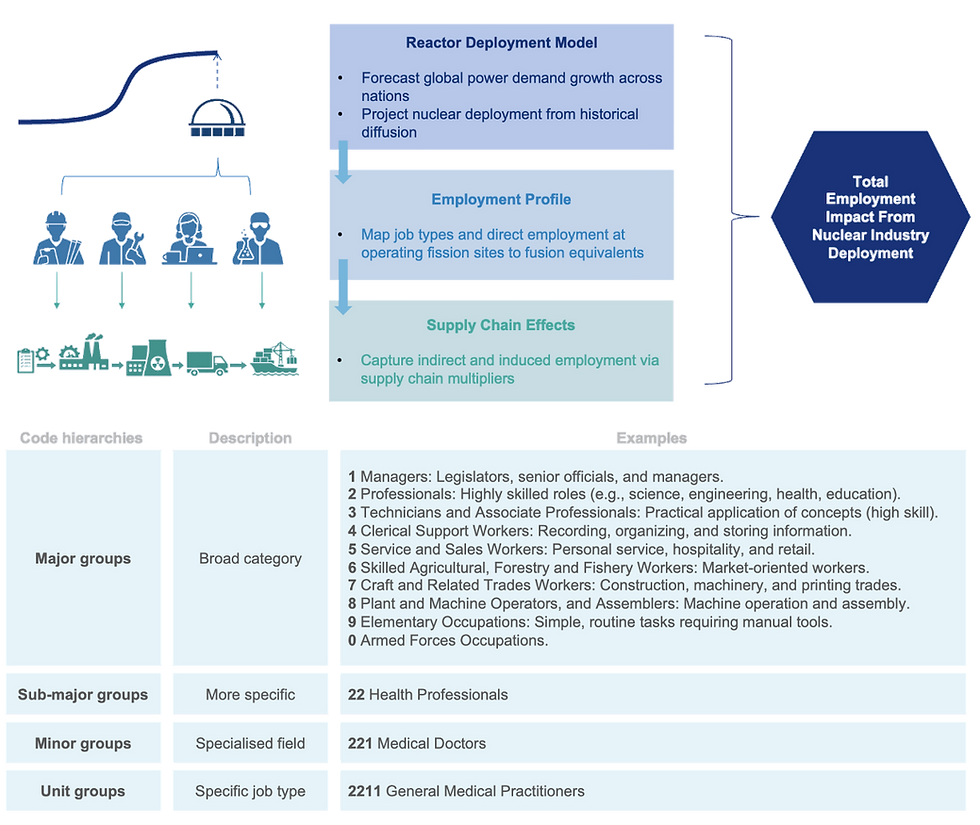
The methodology starts at the level of a single reactor. An employment profile is mapped to ISCO occupational codes, providing a consistent basis for identifying roles and allowing comparison across regions. Direct, indirect, and induced multipliers extend the model beyond the plant boundary to capture broader economic effects. From there, industry-scale employment demand is projected across geographies and plant lifecycle stages, linking individual deployment pathways to aggregate workforce requirements.
The analysis focuses on how decision-makers can quantify and qualify future workforce demand at the national level. Reactor deployment and lifecycle are projected across different geographies, shifting workforce demand in magnitude, composition, and location as projects move from early development through construction and into operation.
What the model shows


Workforce demand moves in phases, not along a smooth curve. R&D, construction, operation, and decommissioning each call for a different workforce. Planning for the average misses all four. Construction in particular concentrates large numbers of workers in a single location for a defined period, requiring mechanisms for workforce centralisation that operation and decommissioning don't.
R&D readiness is not construction readiness. The composition gap between early-stage research workforces and construction workforces is significant. Research talent does not automatically convert into construction capacity, which has direct implications for how training pipelines are structured — they need to be built for both, in sequence, rather than assumed to flow from one into the other.
Deployment pace sets the workforce pace. Fission-paced deployment trajectories imply the fusion workforce doubling twice by 2050. That introduces sustained pressure on education systems, supply chains, and labour mobility. How quickly specialised skills develop, and how well they transfer across regions with different industrial bases, becomes a deployment constraint in itself.
Where the framework needs to grow
Several areas require further development to strengthen this approach. Access to high-quality, real-time labour data remains limited, which constrains validation as the industry evolves. Quantifying relative job value across the supply chain is not yet well defined, particularly when comparing roles across regions and sectors. And translating regional differences in workforce composition into specific training requirements depends on more granular data and closer coordination between industry, governments, and education providers.
Planning for the right workforce
This framework is intended to support planning processes that link infrastructure development with workforce readiness. Connecting deployment curves with labour demand across lifecycle stages and geographies gives policymakers, investors, and suppliers a shared basis for aligning decisions with the actual scale and timing of fusion deployment.
Fusion will be built by people. The planning has to start there.
If you're working on a national fusion strategy, deployment planning, or workforce development and want to explore how this framework applies to your context, get in touch with the Helixos team.


